
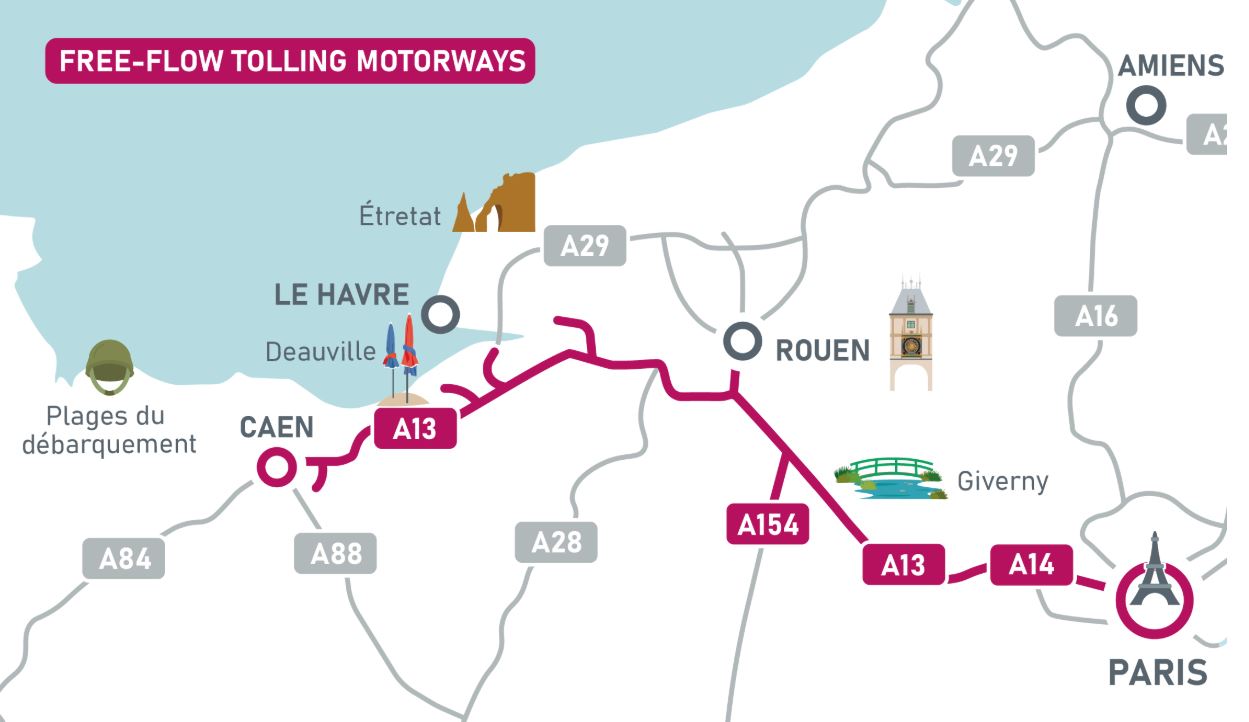
Free-Flow Tolls Map (Photo: Sanef).
Travelers heading from Paris to Normandy in 2026 can expect a smoother journey on the A13 and A14 motorways, thanks to the full implementation of free-flow tolling systems that eliminate traditional booths. However, while some may find this a smoother journey, others, used to the old toll booths where you simply inserted a credit card and a gate lifted, may find this new system very cumbersome
The route to Caen, a key Normandy hub, costs about 28.50 euros for standard passenger cars, with overhead gantries using cameras and sensors to capture license plates or detect electronic badges at highway speeds. This shift, completed in recent years, aims to reduce congestion and environmental impact, aligning with broader French efforts to modernize infrastructure.
Editor’s Note: As explained below, fees/fines are excessive if tolls are not paid on time. I did not realize that I had not paid a fee until I received the 90-euro fine in the mail (it took longer than the allotted grace period to reach me in Colorado). In addition, because I rented a car from Hertz, the company saw fit to hit me with a 20-euro fee for “processing” the fine from French authorities. At the same time, France contacted a U.S.-based collection agency to go after me for the 90 euros, which I paid well in advance, but showed me they aren’t screwing around with these fines. My recommendation is to pay extra for a toll tag system when renting a car.
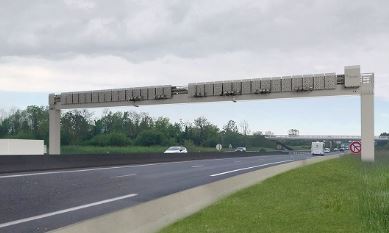
No more toll booths, but you have to know how to pay (Photo: Sanef).
Toll System and How It Works
The free-flow system, known as flux libre, has been active on the A13 since mid-2024 and extended to parts of the A14, allowing vehicles to pass without stopping. Overhead equipment automatically records details for billing, improving traffic flow and cutting emissions from idling. According to government and operator sources, this follows successful trials on other routes like the A79, with similar systems now standard on major French motorways.
Payment Options and Penalties
Drivers have multiple ways to settle tolls: Electronic badges like Bip&Go or Ulys enable automatic debits; online payments via operator Sanef’s website must be made within 72 hours using the license plate; or in-person at Nirio network tobacconists with cash or card. Nonpayment within 72 hours triggers a payment notice sent to the vehicle owner, including the toll amount plus a €90 surcharge, which is reduced to €10 if settled within 15 days of the notice. If the notice remains unpaid after two months, the case is forwarded to state authorities, resulting in a fixed €375 penalty for a class IV offense. Rental car users should review agency policies, as unpaid fees often incur extra charges.
Estimated Costs and Route Breakdown
For Class 1 vehicles, the full Paris-to-Caen toll is approximately 28.50 euros, with segments like Heudebouville at 4.50 euros, Beuzeville at 6.20 euros and Dozule at 4.10 euros. Fees rise modestly each February; a 0.87% average increase is slated for Feb. 1, 2026. These costs support maintenance and upgrades, though critics note the burden on frequent drivers.
Key Considerations: Emissions and City Access
Beyond tolls, Normandy visitors must prepare for Low Emission Zones in cities like Rouen, Caen and Le Havre, requiring Crit’Air stickers on windshields to denote vehicle emission levels. Failure to comply can result in fines. Stickers are available online or at authorized outlets, with requirements varying by zone—Rouen and Caen enforce stricter rules for older vehicles. Travelers are advised to check specific city regulations ahead, especially amid France’s push for greener urban mobility.