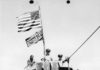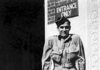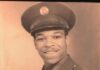

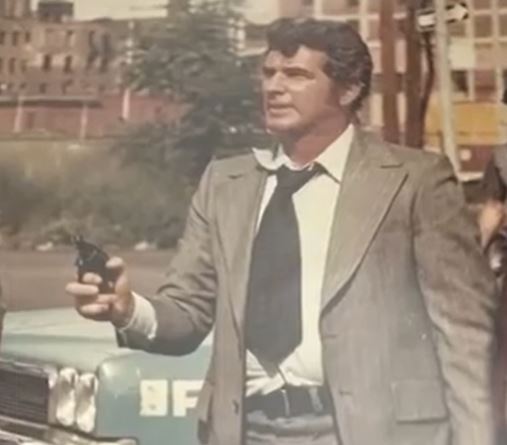
Photo: Mark Russell on Kojak (courtesy Mark Russell).
Mark Russell, who later built a solid career in Hollywood as an actor, says his path to the screen was shaped as much by war as by the movie studios he grew up next to. Raised between New York, Atlanta and Detroit before his family settled in Los Angeles, Russell lived “right next door to Paramount Studios,” where he landed a mailroom job after graduating from Hollywood High. “I got to meet the top guns,” he recalled. “Producers, directors — everybody.” But in 1950, just as his career was beginning, the draft notice arrived.
Russell, 96, was inducted into the U.S. Army on Nov. 3, 1950, and was immediately sent for training, initially in the Coast Artillery, where he chose anti-aircraft. However, after basic training at Fort Ord and Camp Cook, he was assigned to the 40th Infantry Division, a National Guard unit that had fought in several Pacific campaigns in World War II.
“They put me in the infantry with two months of training,” Russell recalled. The division landed in Yokohama, Japan, in late 1950, spending eight months preparing before his 224th Infantry Regiment was sent into Korea. In May 1951, while forward with his squad, he suffered a severe wound during an incoming mortar attack during the battle of Heartbreak Ridge.
After recovering, his unit was relieved by another formation, and Russell was transferred to Koje-do Island. This island was the site of a massive prison-of-war camp that saw repeated uprisings. He served on tower duty with a .50-caliber machine gun to watch over the tense compound. Russell, who received two Bronze Star medals for valor and the Combat Infantryman Badge, described his time in Korea plainly: “It was hell on earth to be there.”
After the war, Russell returned to Hollywood to guest star in numerous movie and television programs including Bonanza, The Fugitive, 12 O’Clock High, The Time Tunnel, Batman, Hogan’s Heroes, Adam-12, Mission: Impossible, Land of the Giants, Ironside, Star Trek: The Original Series, Dragnet 1967, Emergency!, Quincy, M.E., The Odd Couple, Viva Las Vegas and Mannix.
Russell, known to millions as Detective Percy Saperstein on the television series Kojak, recently served as the grand marshal for a parade of American Legion veterans and was honored at the BOLDERBoulder in Colorado.
He often golfed in celebrity pro-ams and eventually settled in Colorado. Today, the longtime actor and veteran says the war shaped his belief in service and country. For Russell, the sacrifices of those who fought — in Korea, in World War II, and in every generation — remain central to his life.
Russell was married to Evellyn for 59 years and had five children. We interviewed Russell in late 2025 in Parker, Colo.
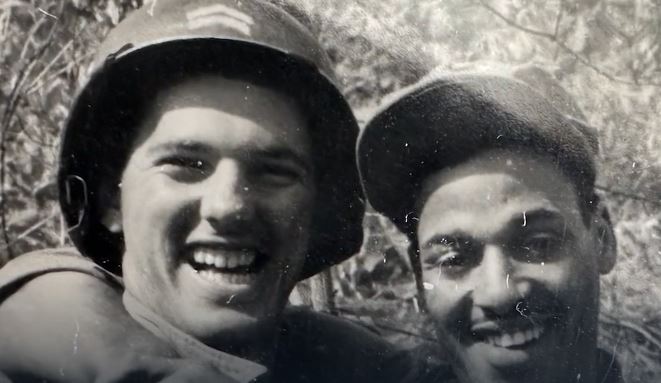
Mark Russell in Korea (Courtesy of Mark Russell).
Interviewer: Mr. Russell, tell us a little about where you grew up and how you ended up in Hollywood.
Russell: I was born in Brooklyn near Coney Island in 1929. When I was four we moved to Atlanta, then Detroit — my dad worked for Macy’s department stores. Both sides of the family were immigrants: mom’s folks came from Germany through Ellis Island around 1898–1900, Dad’s parents fled Hitler from Europe and settled in Ohio. Mom even went to convent school for a few years with Clark Gable. They all became proud American citizens the right way. After my parents divorced, mom, my sister and I moved next door to Paramount Studios in Hollywood. I graduated Hollywood High at 17, went to L.A. City College, and then mom got me a job in the mailroom at Paramount. That’s where I met the big producers and directors — and caught the acting bug.
Interviewer: Then the draft notice came.
Russell: Exactly. I didn’t want to spend six years in the reserves, so I enlisted active duty. November 3, 1950, they put us on a train at Union Station and shipped us off. I wanted to be in Coastal Artillery, but I ended up in the 40th Infantry Division as an infantryman. After basic at Fort Ord and Camp Cooke, we sailed to Yokohama, Japan, trained eight months, and in January 1951 I went in with the advance party of the 224th Infantry Regiment to Korea.
Interviewer: Was there one leader who stood out to you?
Russell: Our sergeant major — a Battle of the Bulge veteran. He taught us the difference between World War II and Korea: in WWII they came at you; in Korea we went to them, met in the valleys, and slugged it out.
Interviewer: You also spent time with the ROK soldiers and even earned a medal with them.
Russell: I loved the ROK troops — tough as nails. They put me in charge of 30 “chickies” — Korean porters, old men and young boys who carried supplies up the mountains on A-frames. One evening we were coming down the ridge at dusk when our own troops mistook us for Chinese and opened fire. Bullets were cracking overhead. I hit the mud, crawled forward with a machine gun across my back, yelling at the chickies in my terrible Korean to shut up and stay low. An old ROK lieutenant finally got our guys to cease fire. I got a medal for keeping those 30 porters alive that night.
Interviewer: Any single soldier you still think about?
Russell: One guy saved my feet from freezing solid — 20 below zero, four hours on guard, four hours trying to sleep. I couldn’t feel them anymore. He dragged me to a fire out of sight of the Chinese, pulled my boots off, and rubbed my feet till circulation came back. He saved my legs — maybe my life. I never forget him.
Interviewer: You also fought at Heartbreak Ridge — what do you remember most about that?
Russell: Twenty-two days of silent warfare, then Gen. Ridgway ordered us to stop firing so the Chinese would build up their supply lines. Once they did, we wiped them out with howitzers and direct fire.
Interviewer: Can you describe what happened during the mortar attack in May 1951—where you were wounded?
Russell: I was laying there with my squad and staff sergeant when the Chinese, very precise with their mortars, dropped a round 15 feet away. Shrapnel tore open my arm (shows scar). I fell to the ground, bleeding to death. Our lieutenant radioed for mass casualty, and two minutes later a gunnery team carried me down the hill. At the base of the hill, our captain was talking to new soldiers to assure them we were in a safe area and not to be alarmed. Then I come by on a stretcher in a bloody mess. They put me in a helicopter. I owe them my life.
Interviewer: What carried you through the worst moments?
Russell: The Good Lord Jesus Christ and love of country. Those of us who fought — and the Greatest Generation before us — we knew what we were fighting for. If you don’t love this country, get your fanny out. Serving in the military makes a man out of you. I still believe every young person should serve—it makes a man out of you.
Interviewer: After you recovered, and you returned to the front lines, where did the Army send you next?
Russell: They sent us first to Pusan, then to Koje-do [Island], the prisoner-of-war camp. I spent my time in a tower on four-hour shifts with a .50-caliber machine gun watching the compound. During one [prisoner] uprising, a sergeant from another squad pulled out his .45 and killed one of the rioters—that squelched it. It was hell on earth to be there.
Interviewer: What did you think of General Douglas MacArthur?
Russell: Loved MacArthur. He believed there’s no substitute for victory. That’s the only way you fight a war — you go all the way or you don’t go.
Interviewer: How do people treat you when they learn you fought in Korea?
Russell: I played a lot of golf — did 48 pro-ams with Jackie Gleason, Foster Brooks—all of the greats. In one tournament, a Korean resident looked at me on the first tee and said, “People told me you fought in Korea — I just want to thank you for our freedom.” I melted right there.
Interviewer: How has being a Korean War veteran affected your life since coming home?
Russell: I visit the Korean War Memorial often, and when descendants ask for photos with me, it does something to my heart. I am so blessed.