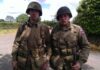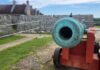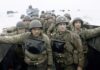


(Cover Photo: First Army Staff and Rangers Gather for Staff Ride. Photo: Regina DeCoster).
POINTE DU HOC, France–The United States First Army recently led a staff ride that retraced the footsteps of U.S. Army Rangers during the June 6, 1944, D-Day invasion here. As part of a combined effort to silence three batteries of giant German guns that threated both Omaha and Utah beaches, the rangers were to seize and destroy the artillery at Pointe du Hoc.
In the predawn hours of June 6, Lt. Col. James Rudder’s 2nd Ranger Battalion scaled Pointe du Hoc’s 100-foot cliffs under intense fire. However, they found that the Germans had moved the guns inland, said Capt. Kevin Braafladt, First Army command historian.
During the initial operations, British sailors operating the LCA landing craft wanted to move the landing far to the west to avoid the currents, Braafladt said. “However, Rudder told them to land directly at Pointe du Hoc. But as they were already misdirected, Easy, Fox and Dog companies all landed on the same spot to the east,” he said.

(Capt. Kevin Braafladt leads staff ride at Pointe du Hoc. Photo: Regina DeCoster).
Because the Royal Air Force and U.S.S. Texas, with its 14-inch guns, pulverized the Pointe, the rangers had a difficult time finding the original scaling sites. “It did not look anything like they prepared for. Water soaked the ropes so that they fell short when fired from the LCAs, which were also not adapted for the explosive charge used to propel the grappling hooks,” he said. “
Most visitors to Normandy go to Point du Hoc to tour the visitor’s center, see giant shell holes created by U.S. Navy and Army Air Force bombing—and are mesmerized by the sheer cliffs that were climbed by the brave rangers. However, Braafladt said the subsequent, and critical, battle for a nearby farm has been less publicized.
One of the lesser-known stories is that of two 101st Airborne Division paratroopers, who were mistakenly dropped in the channel, far from their designated drop zones, that swam to shore and walked east along the coast to join the rangers in the assault on Pointe du Hoc, Braafladt said.
Rangers Fought Through Fire to Silence German Guns South of Pointe du Hoc
After the rangers secured Pointe du Hoc, the sent 50 rangers from Dog and Easy companies south through hedgerows to find the guns. For the first time, the American Army had encountered Normandy’s hedgerows—tightly planted shrubs that were so thick that soldiers could not see what was on the other side—and a natural defense for the Germans.
The rangers made their way to a farm about a mile away where the Germans had set up four 155-millimeter guns with a 25-kilometer range. The guns, discovered by 1st Sgt. Leonard Lomell and Staff Sgt. Jack Kuhn, were under camouflage netting in the farm’s apple orchards. The rangers soon destroyed firing mechanisms and sighting equipment with thermite grenades and rifle butts.
Of the six original French-made guns at Pointe du Hoc, one was destroyed by bombing and another disappeared, leaving the four at the farm, which each had ammunition stockpiled next to them, Braafladt said. “The four guns were in sequence and camouflaged so that aerial reconnaissance could not find them. All were pointed at Utah Beach,” he said.
All hell broke loose when the rangers blew up the guns’ ammunition, signaling to the Germans that they were nearby. “The rangers prepared for a counterattack. They prepared an L-shaped defensive line,” Braafladt said. “After dusk, amid the mortar and artillery shells, the battle heated up. The ranger listening and observation posts were withdrawn into the lines.”

(Capt. Kevin Braafladt with German MG 42 ammo box found at the farm. Photo: Regina DeCoster).
The rangers, low on ammo and food as ships carrying supplies were sunk in the English Channel, fought off the first and second furious German counterattacks. “The rangers had run out of ammo and were firing with captured German MG-42 machine guns. No one knew who was firing in the pitch-black night,” Braafladt said. “At midnight the third counterattack drove the rangers back, through a minefield, to the prepared defensive positions at Pointe du Hoc—across the road that D Company was protecting.”
The rangers held until relieved the next day by elements of the 29th Infantry Division’s 116th Infantry Regiment and the 5th Ranger Battalion.
Lt. Gen. Omar Bradley set up the First Army’s headquarters at the farm a couple of days after the battle. His command arranged the removed the bodies of 32 rangers for burial from the site. Of the 225 rangers who scaled Pointe du Hoc, only about 90 remained after the battle at the farm.

(Then and Now: First Army Staff gathers at farm where Rangers destroyed German Guns. Photo: First Army Public Affairs).
On this farm, Bradley and the Allies would plan Operation Cobra, the breakout from Normandy’s peninsula and the brutal hedgerows. Generals Lawton Collins, Courtney Hodges, Dwight Eisenhower and George Marshall would visit here, along with British Gen. Bernard Montgomery and Prime Minister Winston Churchill. Bradley later said the taking of the guns at Pointe du Hoc was the toughest assignment he gave any unit during the war.

(Lt. Gen. Mark Landes commemorates Rangers and townspeople at ceremony. Photo: Regina DeCoster).
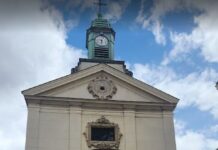
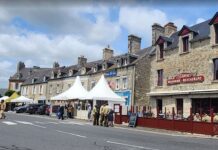
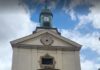
The staff ride, held during the 81st anniversary commemoration of D-Day, also visited Cricqueville-en-Bessin for a wreath-laying ceremony at the town’s church, which has plaques honoring the Rudder and his Rangers. Lt. Gen. Mark Landes, First Army commander and Col. Kitefre Oboho, Ranger Regiment commander, made comments about the courageous rangers, but also praised the town and its mayor for keeping the memory of the fallen alive.
The Cricqueville-en-Bessin town hall has several battle artifacts, including several of the grappling hooks used to climb Pointe du Hoc.